

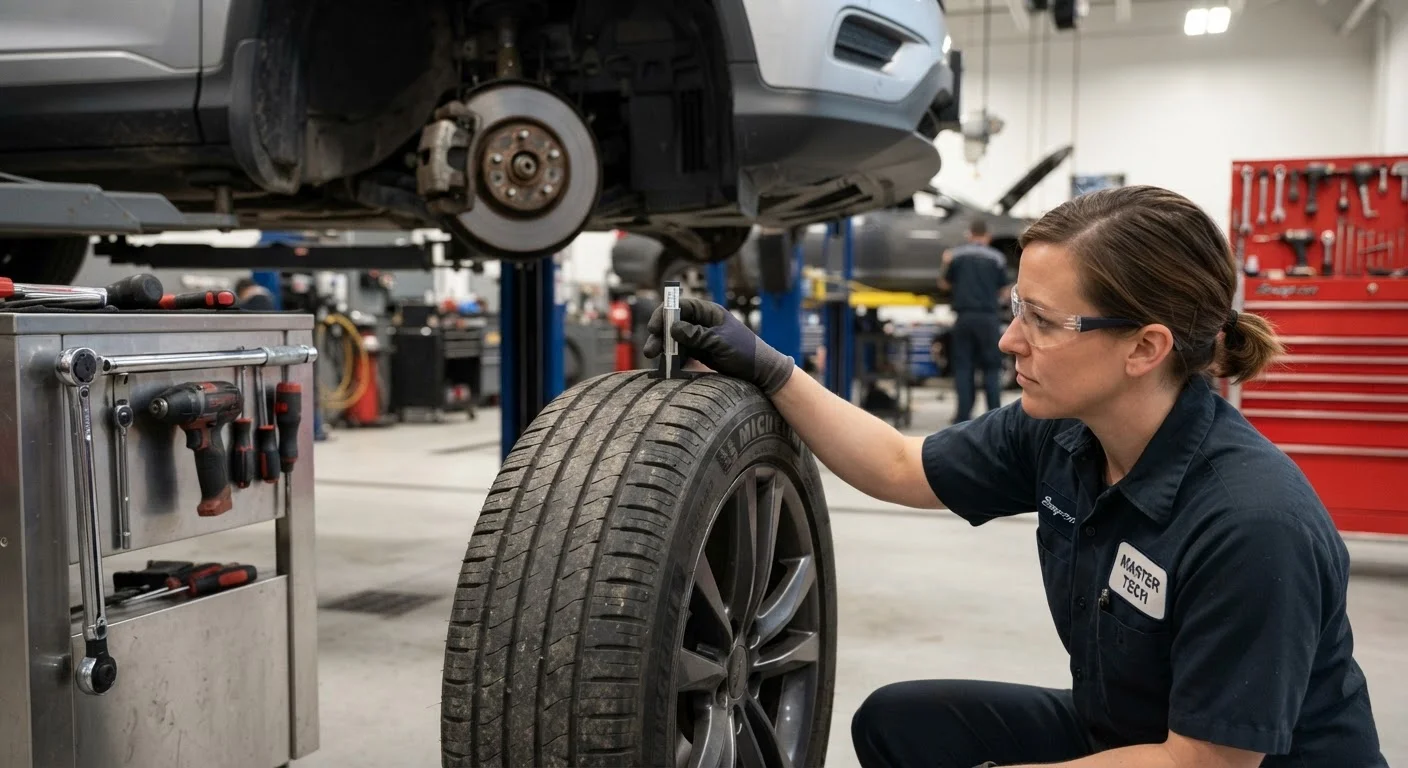
What these three services actually do
Tire rotation, balancing, and alignment are frequently grouped together or confused with one another. They are three different procedures that address different problems. Mixing them up can lead to either skipping something your car needs or paying for something it does not.
Rotation moves tires from one position to another around the vehicle. Front tires typically wear faster than rear tires because they handle steering loads, so moving them to the rear periodically spreads wear more evenly across all four tires. The goal is to get the full useful life out of a set rather than replacing two worn fronts while the rears still have life left.
Balancing corrects uneven weight distribution in a tire and wheel assembly. Even a slight imbalance causes the wheel to wobble or hop at speed. A technician uses a balancing machine to identify heavy spots, then attaches small counterweights to the rim to compensate. Unbalanced tires cause vibration, usually felt through the steering wheel or seat at highway speeds.
Alignment adjusts the angles at which your tires contact the road. Camber, toe, and caster are the three primary angles a technician checks. When these angles are off, the vehicle pulls to one side, the steering wheel sits crooked on a straight road, or tires wear unevenly across the tread width. Alignment does not involve the tires directly; it is an adjustment to the suspension and steering geometry.
Tire rotation
Moving tires from one wheel position to another (front to rear, side to side, or diagonally) to even out wear patterns across all four tires.
Wheel balancing
A procedure that corrects weight imbalances in a tire and wheel assembly using small counterweights, eliminating vibration caused by uneven mass distribution.
Wheel alignment
Adjustment of suspension and steering geometry so that all four tires meet the road at the correct angles. Prevents uneven tread wear and vehicle pull.
Camber
The inward or outward tilt of a tire when viewed from the front. Incorrect camber causes wear on one side of the tread.
Toe
The angle at which tires point inward or outward relative to the vehicle's centerline when viewed from above. Incorrect toe accelerates tread wear across the tire.
Tread wear pattern
The shape and distribution of wear across a tire's surface. Unusual patterns, such as one-sided or cupped wear, can indicate alignment, balance, or suspension problems.
How often each service is typically needed
| Typical rotation interval | Every 5,000 to 7,500 miles (Most manufacturer owner's manuals) |
| Balancing: when needed | At new tire installation and after significant road impacts |
| Alignment check frequency | Once per year or after a major suspension impact |
| Rotation cost range | $20 to $50 (Typical U.S. independent shop pricing) |
| Four-wheel alignment cost range | $75 to $150 (Typical U.S. independent shop pricing) |
| Tire life lost from skipping rotation and alignment | Up to 40% shorter lifespan (General industry estimate) |
Rotation intervals vary by vehicle and tire type, but many manufacturers recommend rotating tires every 5,000 to 7,500 miles. For many drivers, that lines up with an oil change, which makes it easy to bundle both services. Check your owner's manual for the manufacturer's specific recommendation since all-wheel-drive vehicles and certain tire designs have different requirements.
Balancing is usually done when new tires are installed and again if you notice vibration at highway speeds. Road impacts, such as hitting a pothole, can knock a wheel out of balance. Some shops include a balance check with every rotation; others charge separately. If your car develops a new vibration that was not there before, a balance check is a reasonable first step before more expensive diagnosis.
Alignment does not follow a fixed mileage interval the way rotation does. Most mechanics suggest checking it once a year or after any significant suspension impact, such as hitting a deep pothole, curb, or road debris. If a tire shows unusual wear, such as the inner or outer edge wearing much faster than the center, that is a practical signal to check alignment rather than just replace the tire. Replacing a tire without addressing an alignment problem will wear out the new tire on the same pattern.
For a broader view of which maintenance tasks to prioritize and when, see the vehicle maintenance schedule guide for context on how these services fit into the full picture.
Signs something is wrong and what the cost looks like
Each service has recognizable warning signs worth knowing:
- Vibration through the steering wheel or floor at 50 to 70 mph often points to a balance issue.
- The car pulling left or right on a straight, level road suggests an alignment problem, though tire pressure should be checked first since unequal pressure can mimic the same symptom.
- Cupping or scalloping across the tread (a wavy, uneven wear pattern) can indicate both balance and suspension issues.
- One-sided shoulder wear, where only the inner or outer edge of a tire is worn, usually points to an alignment issue.
On cost: rotation is typically the least expensive of the three, often ranging from around $20 to $50 depending on the shop. Balancing a set of four tires generally runs $40 to $80. A full four-wheel alignment typically costs $75 to $150 at an independent shop, though prices vary by region and vehicle type. Luxury, sport, and all-wheel-drive vehicles with more complex suspension systems often sit at the higher end of that range.
Bundling rotation with balancing at the same appointment is common and can reduce the total cost compared to scheduling them separately. If your shop offers a tire rotation and balance as a combined service, confirm what is actually included so you are not paying for both when only one is needed.
Skipping rotation and alignment checks costs more over time through accelerated tire wear. A set of tires that should last 50,000 to 60,000 miles can wear out in 30,000 to 35,000 miles if alignment and rotation are consistently neglected, which more than offsets any short-term savings from skipping appointments.
The content provided on our blog site traverses numerous categories, offering readers valuable and practical information. Readers can use the editorial team’s research and data to gain more insights into their topics of interest. However, they are requested not to treat the articles as conclusive. The website team cannot be held responsible for differences in data or inaccuracies found across other platforms. Please also note that the site might also miss out on various schemes and offers available that the readers may find more beneficial than the ones we cover.