

Our Verdict
The avalanche method saves more money over time by attacking high-interest debt first. The snowball method wins on motivation for households that need visible progress to stay the course. There is no universally correct choice; the better method is whichever one a household will actually stick with.
| Best for | Recommended |
|---|---|
| Households carrying high-interest credit card or personal loan debt | Avalanche method |
| Those who have struggled to stay motivated with debt repayment before | Snowball method |
| Disciplined budgeters focused purely on minimizing total interest paid | Avalanche method |
| Families juggling many small balances across multiple accounts | Snowball method |
How each method works
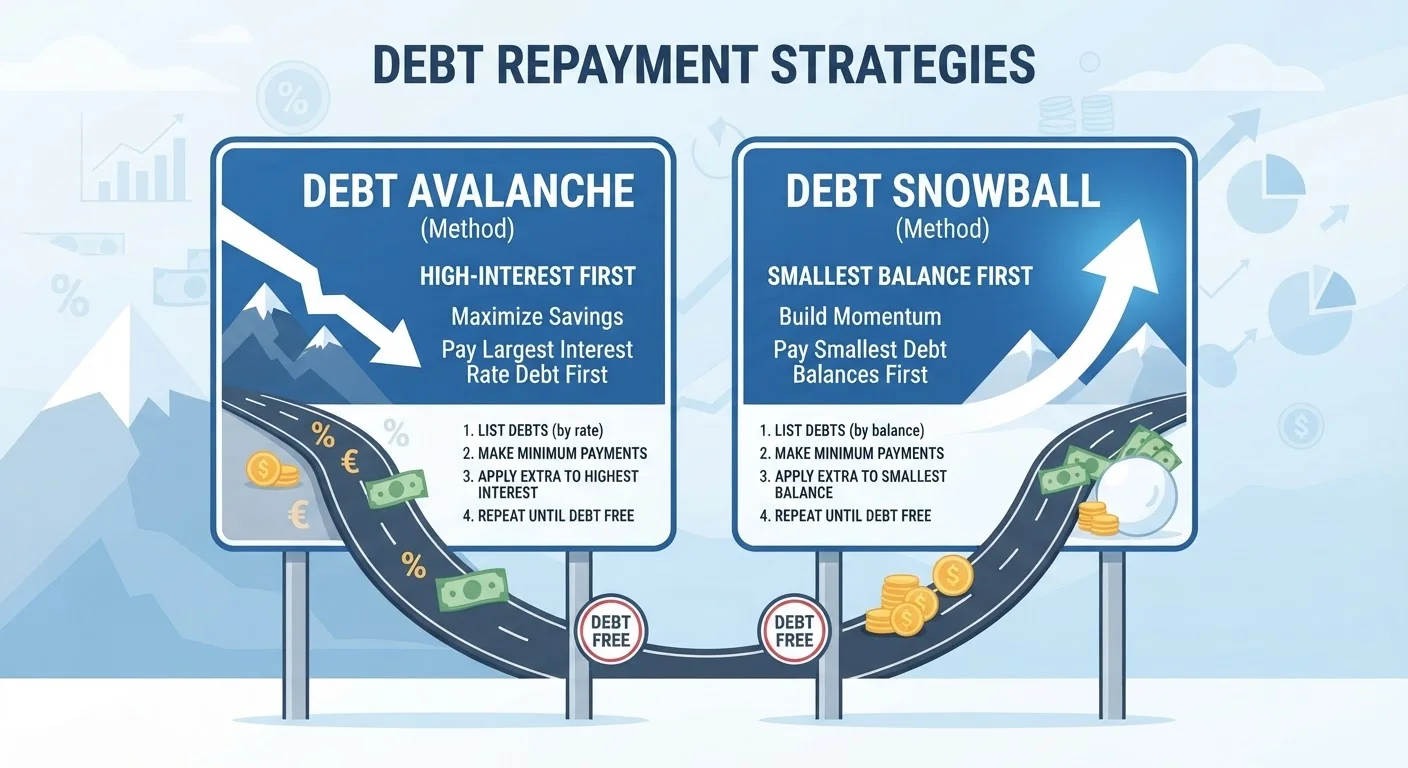
Both strategies share one core mechanic: you pay minimums on all debts, then direct any extra payment capacity toward one target account. When that account is paid off, you roll its former payment into the next target. The difference is how you rank targets.
With the avalanche method, you rank debts by interest rate, highest to lowest. The account charging the most interest gets all extra dollars first. Once it is gone, you move to the next highest rate.
With the snowball method, you rank debts by balance, smallest to largest, regardless of interest rate. The smallest account is eliminated first, freeing up that minimum payment to attack the next smallest.
Neither method asks you to find new money. Both work by recycling payments as each account closes, so the amount you throw at debt grows over time without requiring a budget change.
| Avalanche method | Snowball method | |
|---|---|---|
| Ranking order | Highest interest rate first | Smallest balance first |
| Total interest paid | Lower over the full payoff | Higher if rates vary widely |
| Time to first account closed | Slower if high-rate debt is large | Faster; smallest balance closes first |
| Psychological momentum | Builds later; requires patience | Builds quickly through early wins |
| Complexity | Requires tracking interest rates | Only requires tracking balances |
| Best suited for | Cost-focused, disciplined planners | Those needing visible early progress |
The real cost difference
The avalanche method consistently produces a lower total interest cost. When high-rate debt sits untouched while you clear low-balance, lower-rate accounts, interest compounds on that balance every month. The longer it lingers, the more you pay.
The gap between methods varies depending on how different the interest rates are across your accounts. If your debts carry similar rates, the difference in total interest may be small. If you have a 24% APR credit card sitting behind several low-rate loans in the snowball queue, the cost difference can be substantial over a two- to three-year payoff period.
A concrete illustration: imagine a household with three debts totaling $12,000, where the largest balance also carries the highest rate. The snowball clears two small accounts quickly but leaves that high-rate balance accruing interest throughout. The avalanche attacks that balance immediately, reducing the principal that compounds every month. Over a 30-month payoff window, the interest saved by using the avalanche in that scenario could reach several hundred dollars, though the exact figure depends on individual balances, rates, and payment amounts.
For households carrying high-interest credit card debt specifically, this difference is worth taking seriously. Credit card APRs in the US have averaged above 20% in recent years according to Federal Reserve data, meaning balances on those accounts grow quickly when underpayment continues.
The motivation factor
Personal finance researchers and financial counselors have noted for years that mathematical optimality is not the only variable that matters. A plan that someone abandons after three months costs far more than a slightly less efficient plan that runs to completion.
The snowball method produces faster early wins. Closing an account, even a small one, removes a creditor from your list and frees a minimum payment. That freed payment creates visible momentum. For households that have tried and abandoned debt repayment before, this psychological feedback is real and worth weighing against the interest cost difference.
The avalanche asks for patience. You may direct extra payments at a large, high-rate balance for many months before the balance meaningfully shrinks, and other accounts continue accruing interest in the background. Some households find this discouraging. Others find the knowledge that they are minimizing cost motivating enough to sustain the effort.
Track your payoff date, not just your balance
Many free budgeting tools let you enter your debts and simulate both avalanche and snowball timelines side by side. Running this exercise with your actual numbers shows the concrete cost difference for your specific situation rather than a generic example. Knowing your estimated payoff date in months also gives you a fixed target, which tends to sustain effort better than watching a balance decrease slowly.
There is also a hybrid approach some households use: pay off one or two small balances quickly to simplify the account list and gain early momentum, then switch to avalanche order for the remaining debts. This is not a formally named strategy, but it can suit households where both motivation and cost matter.
Setting up either method in practice
Before choosing, list every debt with its current balance, minimum payment, and interest rate. That list is the only tool both methods require to get started.
For the avalanche, sort the list by interest rate (highest at top). Set all minimums, then assign any surplus to row one. For the snowball, sort by balance (smallest at top) and do the same.
Automation helps both methods. Scheduling a fixed extra payment to the target account each month removes the decision from your monthly routine and reduces the chance of redirecting those dollars elsewhere.
One consistent risk for both methods is adding new debt during the payoff period. Every new balance resets your progress partially and extends your timeline. If your spending habits tend to push card balances back up, addressing that pattern alongside the repayment strategy matters as much as which order you pay accounts. Pairing either method with a structured savings habit, such as the approach described in sinking funds for planned expenses, can reduce the need to reach for credit when irregular costs arrive.
This article is for general informational purposes only and is not personalized financial advice. For guidance specific to your situation, consult a qualified financial professional.
The content provided on our blog site traverses numerous categories, offering readers valuable and practical information. Readers can use the editorial team’s research and data to gain more insights into their topics of interest. However, they are requested not to treat the articles as conclusive. The website team cannot be held responsible for differences in data or inaccuracies found across other platforms. Please also note that the site might also miss out on various schemes and offers available that the readers may find more beneficial than the ones we cover.