

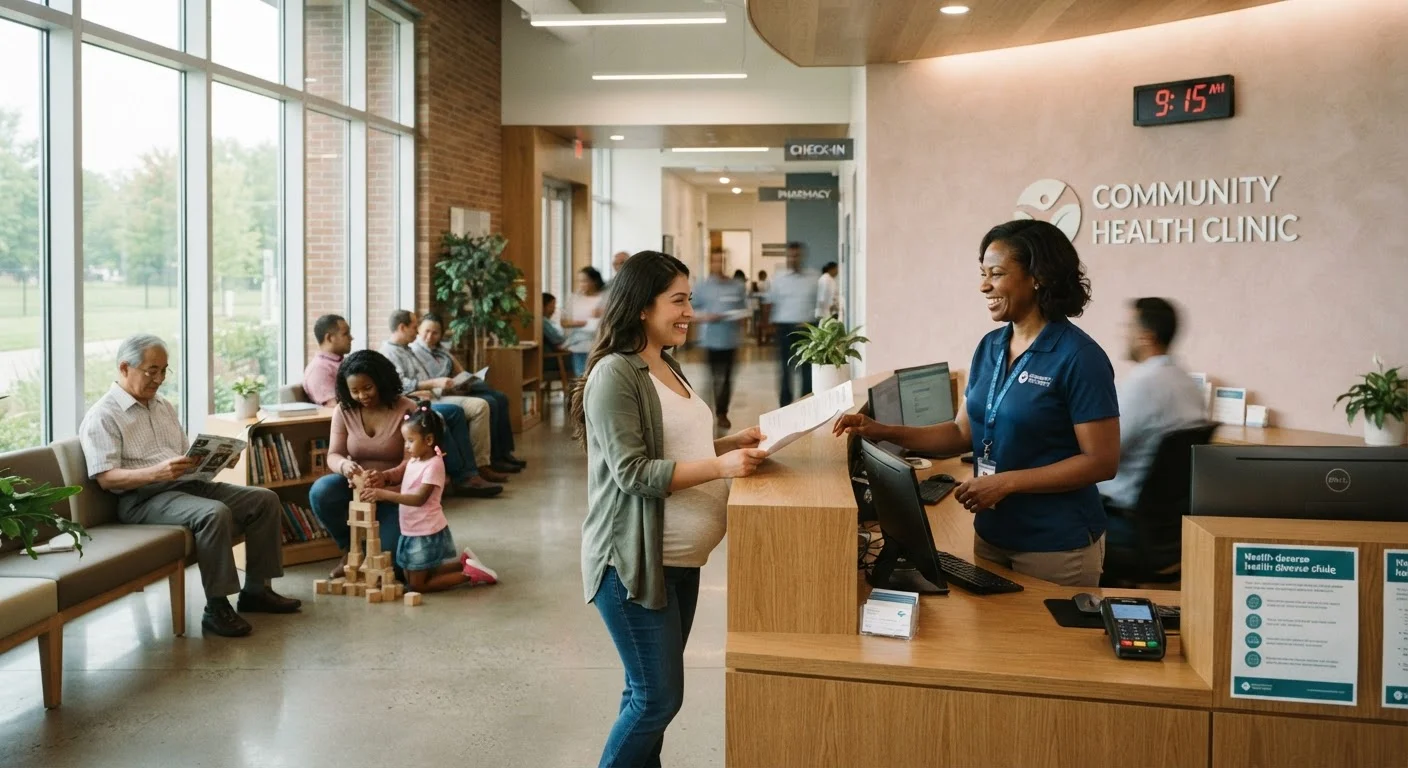
How community health centers work
Community health centers operate under a federal grant program administered by the Health Resources and Services Administration (HRSA). To receive federal funding, a center must be located in a medically underserved area or serve a medically underserved population, be governed by a community board (at least 51% of board members must be patients), and offer care regardless of patients' ability to pay.
That last requirement is the practical core of the model. When a patient cannot afford the standard fee, the center uses a sliding-fee schedule to determine a reduced charge. The schedule is anchored to the Federal Poverty Level, a number published annually by the U.S. Department of Health and Human Services. A family earning below 100% of the FPL typically qualifies for the deepest discount or no charge at all; fees rise incrementally as income rises above that threshold.
Because CHCs bill Medicaid and Medicare at enhanced rates, they can recover enough revenue to keep the sliding-fee scale sustainable for uninsured patients. This cross-subsidy model is what makes the system financially viable without requiring patients to pay the full cost of care.
FQHCs versus look-alike centers
Not every community clinic carries the full FQHC designation. Some operate as FQHC Look-Alikes, meaning they meet the same program requirements but do not receive Section 330 grant funding. Look-alikes still use sliding-fee scales and serve the same populations, but their financial structure differs slightly. When searching for a center, the HRSA finder tool identifies both types.
Who qualifies and who they serve
There is no formal eligibility screen to walk through the door. Anyone can visit a community health center, and staff will work with you to establish a fee based on your income. In practice, CHCs most often serve low-income individuals and families, Medicaid enrollees, uninsured adults, agricultural workers, homeless individuals, and residents of public housing.
According to HRSA data, health centers collectively serve more than 30 million patients annually across the United States. A significant share of those patients are children, and a large proportion live at or below the poverty line. A substantial number are best served in languages other than English, and many CHCs offer interpretation services or multilingual staff to meet that need.
Families with insurance can use a CHC too. If your plan is accepted, the center will bill it normally. The sliding-fee scale applies only to whatever out-of-pocket costs remain after insurance pays its share.
30M+
Patients served by CHCs annually
According to HRSA data on the federal Health Center Program.
1,400+
Federally funded health center organizations
Operating across all 50 states, Washington D.C., and U.S. territories, per HRSA.
~62%
Patients at or below the federal poverty level
HRSA Health Center Program data shows the majority of CHC patients are low-income.
What services you can typically expect
Most Federally Qualified Health Centers function as one-stop primary care sites. A standard visit can cover sick care, chronic disease management (such as diabetes or hypertension), immunizations, prenatal care, and well-child checkups. Many locations also house dental clinics, behavioral health counselors, and on-site pharmacies, all under the same sliding-fee structure.
The breadth of services matters for families trying to limit how many separate appointments they need. Getting a child's physical, a flu shot, and a dental cleaning in one place with one co-pay (or one sliding-fee calculation) is simpler and often cheaper than visiting three separate providers.
For preventive services covered under the Affordable Care Act, you may owe nothing even before the sliding-fee scale applies. See our guide to no-cost preventive care for a detailed breakdown of what those services include.
This article is for general informational purposes only and is not medical or financial advice. For guidance specific to your health situation, please consult a qualified healthcare professional.
Frequently Asked Questions
No. Community health centers accept patients with or without insurance, including those on Medicaid, Medicare, or private plans, as well as uninsured individuals. If you have no coverage, you will be charged on a sliding-fee scale based on your income.
The fee is based on your household income compared to the Federal Poverty Level (FPL) and the number of people in your family. Patients at or below a certain percentage of the FPL may pay very little or nothing at all. The health center will ask for documentation such as a pay stub or tax return to determine your fee level.
Most CHCs provide primary medical care, dental care, behavioral health services, and pharmacy services. Many also offer vision care, substance use treatment, and case management. Services vary by location, so it is worth calling ahead to confirm what is available at your nearest center.
No, though both serve low-income patients. Free clinics are typically volunteer-run and donation-funded, with no guaranteed funding floor. FQHCs receive federal grants, must meet specific quality and reporting standards, and are required by law to provide care regardless of ability to pay.
Yes. Community health centers do not require proof of citizenship or immigration status to receive care. Their mission is to serve all residents of their designated service area.
The HRSA Health Center Finder at findahealthcenter.hrsa.gov lets you search by ZIP code or city. You can also call 1-877-464-4772 (the HRSA information line) for assistance locating a center in your area.
The content provided on our blog site traverses numerous categories, offering readers valuable and practical information. Readers can use the editorial team’s research and data to gain more insights into their topics of interest. However, they are requested not to treat the articles as conclusive. The website team cannot be held responsible for differences in data or inaccuracies found across other platforms. Please also note that the site might also miss out on various schemes and offers available that the readers may find more beneficial than the ones we cover.