

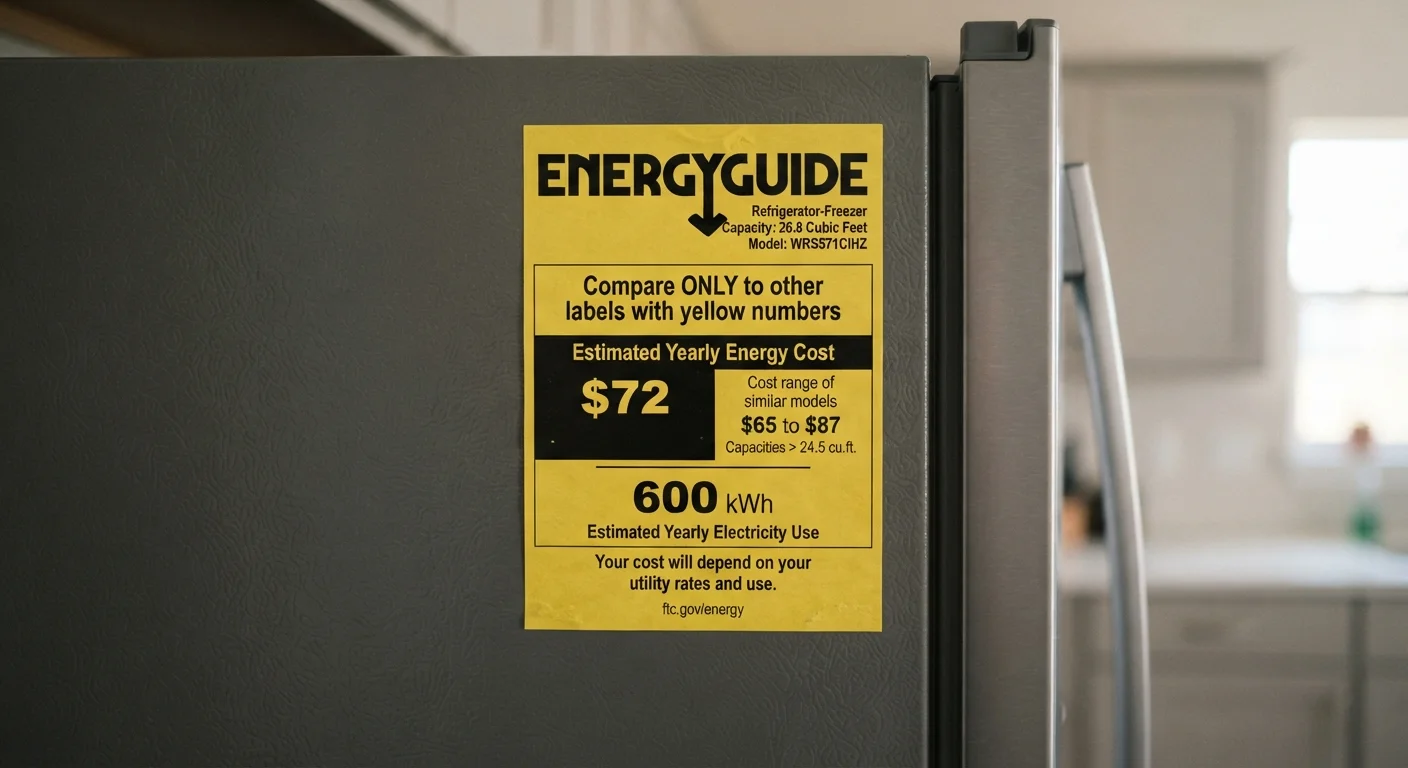
What the yellow EnergyGuide label actually shows
The bright yellow EnergyGuide label is required by the Federal Trade Commission on most major appliances sold in the US. It has three main pieces of information: the appliance's estimated annual energy consumption in kilowatt-hours (kWh), the estimated annual operating cost in dollars, and a comparison bar showing where that model sits among similar products.
The kilowatt-hour figure is the most useful number for comparing two models head to head. It reflects actual measured energy consumption under standardized test conditions set by the Department of Energy. The dollar estimate, by contrast, uses a national average electricity rate that may not match what your utility charges. If your rate is above the national average, your real cost will be higher than the label suggests.
The comparison bar runs from lower to higher energy use across similar models. A model that falls toward the left end of the bar consumes less energy than most comparable appliances in its category. This bar is recalculated periodically as the market changes, so an older label and a newer one may use different comparison ranges.
Use kWh, not the dollar estimate, for comparisons
The dollar figure on a EnergyGuide label is calculated using a national average electricity rate, which changes periodically and may not reflect your local rate. To compare two models accurately, look at the kilowatt-hour-per-year figure instead. You can then multiply that number by your actual rate, found on your utility bill, to get a realistic annual cost estimate.
What ENERGY STAR certification adds
ENERGY STAR is a voluntary program administered by the US Environmental Protection Agency. A product that carries the ENERGY STAR mark has been independently verified to meet efficiency thresholds the EPA sets for each product category. Those thresholds are generally set well above the federal minimum standards.
The certification is pass-or-fail. There is no numerical ENERGY STAR score on most products. Within some categories, the EPA designates a subset of products as 'ENERGY STAR Most Efficient' for models that significantly exceed the standard threshold, but this is separate from the basic certification.
Manufacturers submit test data, and some categories require third-party testing. The EPA publishes a searchable list of certified products on its website, which lets you verify a claim before relying on it.
9%
Minimum efficiency improvement for ENERGY STAR refrigerators
According to the EPA, ENERGY STAR-certified refrigerators must use at least 9% less energy than the federal minimum standard to qualify.
30%
Typical efficiency gain for ENERGY STAR clothes washers
The EPA states that ENERGY STAR-certified clothes washers use about 25 to 30% less energy than standard models meeting only federal minimums.
kWh/year
Standard unit on EnergyGuide labels for most appliances
The Federal Trade Commission requires kilowatt-hours per year as the primary consumption figure on EnergyGuide labels for refrigerators, dishwashers, and washing machines.
Metrics that vary by appliance type
Different appliances use different efficiency metrics, and the EnergyGuide label reflects that. Refrigerators and dishwashers show kWh per year. Central air conditioners use a Seasonal Energy Efficiency Ratio (SEER), where a higher number means greater efficiency. Furnaces use an Annual Fuel Utilization Efficiency (AFUE) percentage, representing how much of the fuel burned actually heats your home. Water heaters use the Uniform Energy Factor (UEF), which replaced the older Energy Factor metric to make comparisons across heat pump, gas, and electric storage models more consistent.
When comparing appliances in the same category, the label metric is the right starting point. When comparing across fuel types, such as a gas water heater versus an electric heat pump water heater, the calculation gets more involved because electricity and gas are priced differently per unit of energy.
What the labels do not tell you
Energy labels measure efficiency under controlled test conditions. Real-world performance depends on how and where an appliance is used. A refrigerator placed next to a heat source will use more energy than its label suggests. A washing machine run primarily on cold cycles will use less than the label estimate, which assumes a mix of temperatures.
The labels also say nothing about reliability, noise, or overall build quality. An appliance with excellent energy numbers may have a shorter lifespan or require more maintenance. Efficiency data and durability data come from separate sources, and the label only covers the former.
Finally, an older appliance that was certified when standards were lower may carry an ENERGY STAR mark that no longer reflects current performance tiers. Certification is based on the standards in place at the time of testing, not continuously updated against new thresholds.
Certification dates and current standards
ENERGY STAR thresholds are updated over time as technology improves and the market shifts. A product certified several years ago may have met the threshold in effect at the time but would not necessarily qualify under today's standards. If you are evaluating an older appliance or a floor model, check the EPA's current certification requirements for that product category to understand where the threshold now sits.
Frequently Asked Questions
It is the estimated annual cost to run the appliance based on a national average utility rate set by the US Department of Energy. Your actual cost will be higher or lower depending on what your utility charges per kilowatt-hour. Use the kilowatt-hour figure for a more consistent comparison between models.
No. The EnergyGuide label is a federally required disclosure that appears on most major appliances; it shows energy use data but does not pass or fail a product. ENERGY STAR is a separate voluntary certification program run by the EPA. A product can carry the EnergyGuide label without qualifying for ENERGY STAR.
ENERGY STAR is a pass-or-fail certification, not a scored scale. A product either meets the efficiency threshold or it does not. Some categories have a 'Most Efficient' designation for products that far exceed the standard threshold, but this is a subset of the regular certification.
Savings depend on usage habits, local utility rates, and how efficient your current appliance is. The EPA publishes general estimates for each product category on its website, but these are averages. Comparing the kilowatt-hour figures on two labels gives a more reliable picture for your situation than relying on marketing claims.
Most major household appliances sold in the US are required to carry the label, including refrigerators, dishwashers, washing machines, water heaters, air conditioners, and furnaces. Some product categories, such as kitchen ranges, are exempt. The Federal Trade Commission administers the labeling requirement.
The Uniform Energy Factor (UEF) is the efficiency metric used for water heaters in the US. It appears on the EnergyGuide label for those products. A higher UEF means greater efficiency. It replaced the older Energy Factor (EF) metric to allow more consistent comparisons across different water heater types.
The content provided on our blog site traverses numerous categories, offering readers valuable and practical information. Readers can use the editorial team’s research and data to gain more insights into their topics of interest. However, they are requested not to treat the articles as conclusive. The website team cannot be held responsible for differences in data or inaccuracies found across other platforms. Please also note that the site might also miss out on various schemes and offers available that the readers may find more beneficial than the ones we cover.