

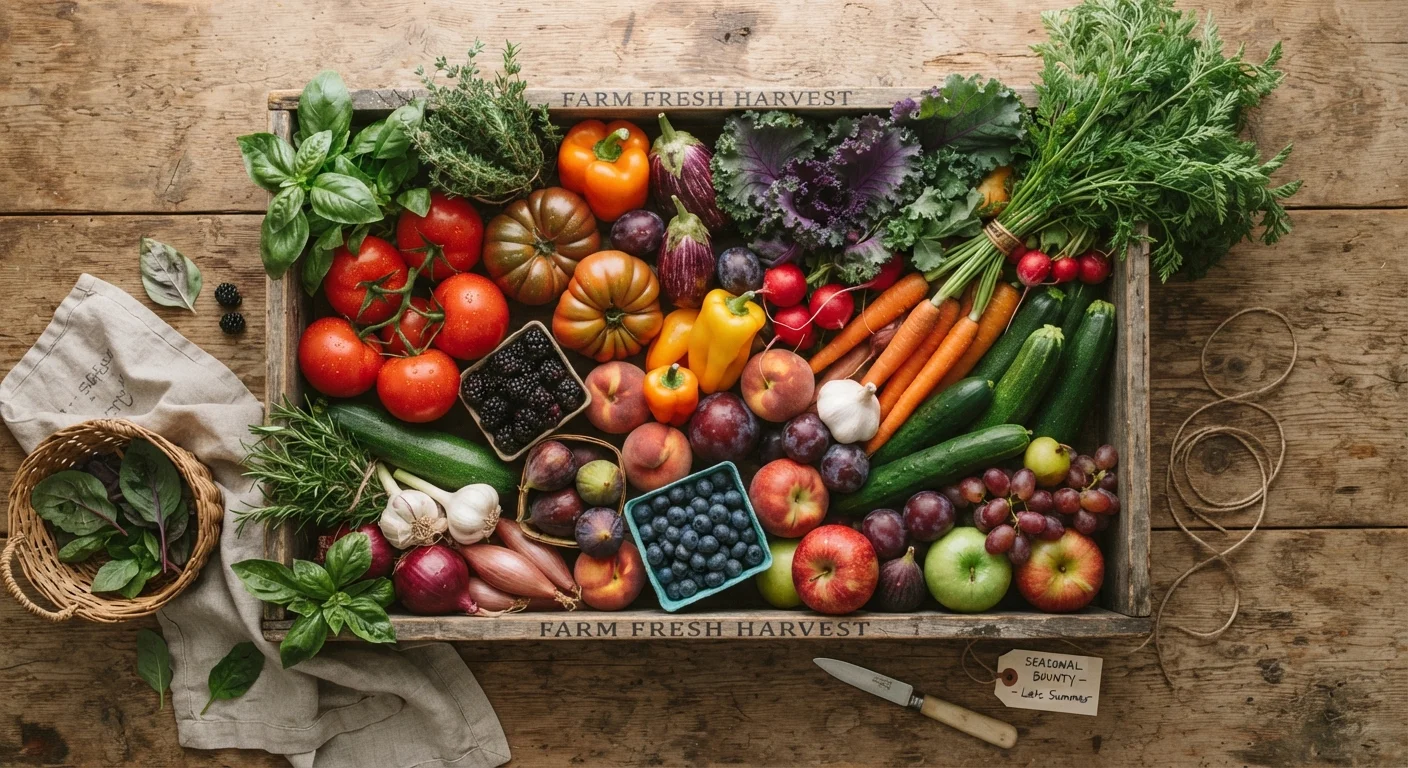
Why produce prices move with the calendar
Price at the grocery store is largely a function of supply and shipping cost. When a crop comes in at peak harvest, growers have large volumes to sell within a short window before the product spoils. That pressure pushes prices down. When the same crop is sold out of season, it either comes from a distant growing region (adding freight cost) or from cold storage (adding handling and energy cost). The consumer pays for both.
Summer tomatoes grown regionally and sold within days of harvest carry almost none of that overhead. The same tomatoes bought in January have likely traveled from Mexico or Florida, or spent weeks in a controlled-atmosphere warehouse. Neither option is inherently wrong, but the price difference is real and predictable.
This pattern is not a marketing concept. It follows the basic logic of agricultural economics: high supply relative to demand lowers price, and lower logistics cost means less is added to the retail price before the item reaches the shelf.
What the savings actually look like
A few concrete comparisons illustrate the range. Bell peppers in peak summer can run under a dollar each at many supermarkets; by mid-winter, the same pepper often costs two to three times that. Butternut squash in October and November, when regional harvests peak across much of the country, regularly sells for well under a dollar per pound. Off-season, that price can double. Strawberries in May or June in most of the U.S. are among the most affordable fruits per pound on the shelf; in December, they are among the most expensive.
30-60%
Typical price premium for out-of-season produce
Price differences of this range are common for perishable crops that require long-haul refrigerated shipping when grown out of region.
~$0.50/lb
Average peak-season price for butternut squash
Butternut squash regularly hits this price point at supermarkets during October and November regional harvests across much of the U.S., roughly half its off-season cost.
4-5x
Ears of corn per dollar at peak harvest vs. shoulder months
At farm stands and some supermarkets during peak Midwest corn season, pricing can drop to this level compared to one ear per dollar in May or early September.
The savings are not limited to farmers markets or specialty grocers. Standard supermarkets reflect the same supply dynamics, though their pricing may smooth out some of the extremes through regional distribution networks. For families trying to stretch a grocery budget, produce timing is one of the few levers that requires no coupons, no loyalty app, and no special store access.
How regional calendars differ from generic lists
A national "what's in season" list is a rough guide at best. Asparagus peaks in April in Pennsylvania and in February in California. Corn is a July crop in the upper Midwest and a May or September crop in parts of the South. If you follow a list built for a different climate zone, you may buy at the wrong time and miss the price window entirely.
The most reliable source for your area is a state cooperative extension service, which publishes crop calendars tied to local growing conditions. Your local farmers market is also a practical indicator: vendors sell what is actually ripe, so the stalls are a live snapshot of regional peak supply. This specificity matters because the price drop is tied to local or regional abundance, not to what is technically in season somewhere in the country.
Families who track this over a single year tend to internalize the pattern quickly. The same vegetables appear at lower prices in roughly the same weeks each year, which makes it possible to plan meals and even batch-cook or freeze accordingly. That approach connects directly to avoiding the grocery habits that quietly drain budgets, particularly buying expensive out-of-season produce out of habit rather than need.
Extending the savings through preservation
Buying in season does not have to mean eating only what is peak right now. Freezing, pickling, and simple refrigerator storage can extend the value of a seasonal purchase by weeks or months. A flat of tomatoes bought at peak-season pricing can become sauce that lasts through winter. Zucchini bought cheaply in August can be shredded and frozen for baked goods through fall. Corn can be blanched and frozen in under an hour.
None of these techniques require special equipment beyond a freezer and basic kitchen tools. The practical payoff is that a family can buy a larger quantity at the lowest price point, process it once, and avoid paying premium out-of-season prices later. This is the logic behind the idea that eating well on a limited budget is more achievable than it appears: the timing of the purchase, not the item itself, often determines the cost.
For families building a seasonal rhythm, a simple produce calendar posted in the kitchen, marked with the months when key items are cheapest locally, is a practical starting point. Over time, meal planning around that calendar becomes a natural habit rather than an extra step.
Frequently Asked Questions
It varies by crop and region, but price differences of 30 to 60 percent are common for items like stone fruit, berries, and winter squash. The gap is widest for perishable crops that require refrigerated shipping when grown out-of-region.
Many state cooperative extension services publish regional harvest calendars online, and USDA resources cover broad seasonal patterns by growing zone. Your local farmers market is also a reliable real-time indicator of what is actually at peak supply.
No. Conventional supermarkets stock seasonal produce alongside year-round items, and the pricing difference is usually visible on the shelf. Farmers markets and farm stands can offer steeper discounts at peak harvest, but they are not necessary for seasonal savings.
Frozen vegetables and fruits are typically processed at peak ripeness, so their nutritional profile holds up well. For most cooked applications, frozen is a practical and cost-effective alternative during off-season months.
Produce harvested at full ripeness and sold locally has had less time in transit or cold storage, which tends to preserve texture and flavor. Whether the difference is noticeable depends on the specific item and how far out-of-season the comparison is.
The content provided on our blog site traverses numerous categories, offering readers valuable and practical information. Readers can use the editorial team’s research and data to gain more insights into their topics of interest. However, they are requested not to treat the articles as conclusive. The website team cannot be held responsible for differences in data or inaccuracies found across other platforms. Please also note that the site might also miss out on various schemes and offers available that the readers may find more beneficial than the ones we cover.