

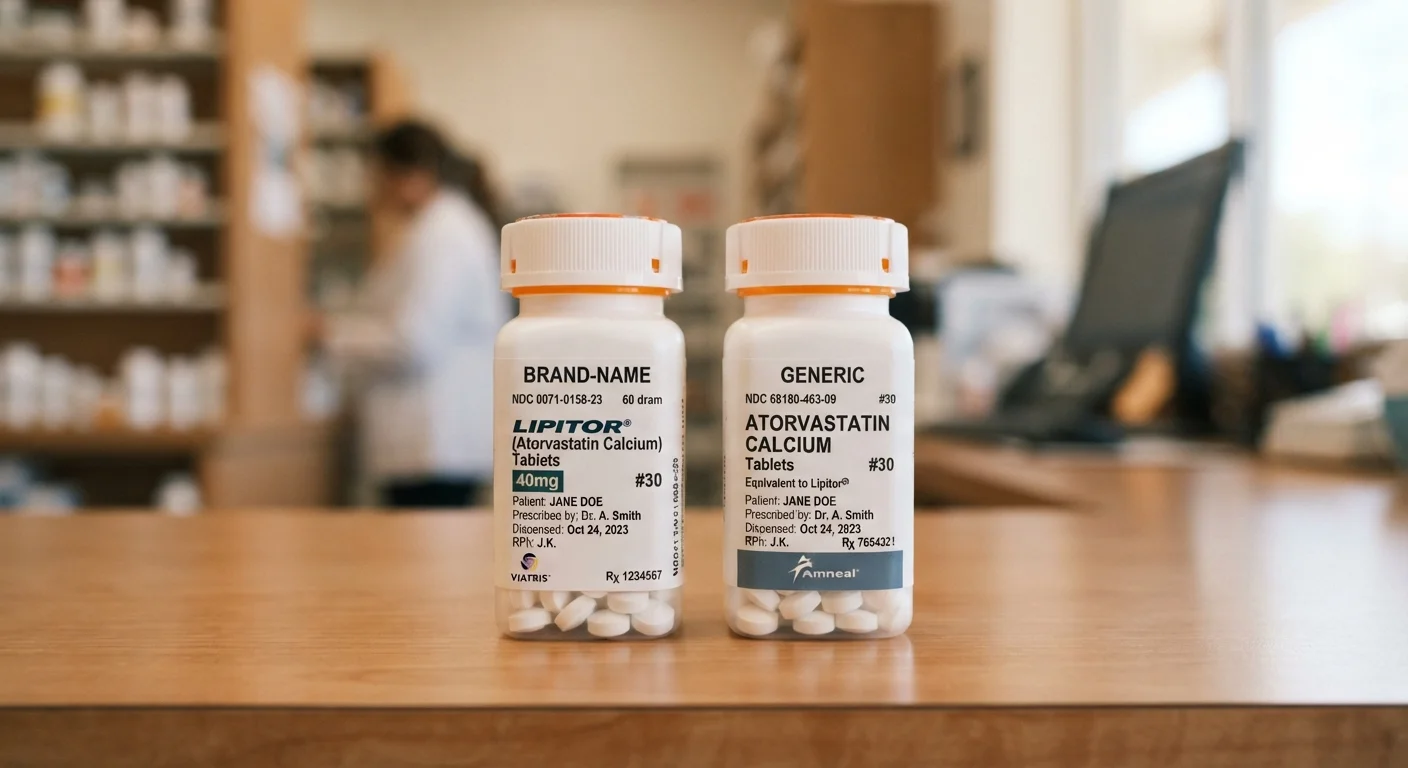
Option A
Generic medications
The FDA-approved, lower-cost equivalent.
Best for: Families managing ongoing prescription costs who want proven, regulated alternatives to brand-name drugs.
Option B
Brand-name medications
The original, patent-protected formulation.
Best for: Situations where a specific formulation, delivery mechanism, or inactive ingredient profile is clinically necessary.
How the FDA defines equivalence
When a brand-name drug's patent expires, other manufacturers can apply to the FDA to produce a generic version. To receive approval, the generic must pass a bioequivalence review: a process that confirms the drug delivers the same amount of active ingredient into the bloodstream at roughly the same rate as the original. The FDA allows a confidence interval of 80 to 125 percent for bioequivalence, a range that applies equally to the brand-name drug itself when tested batch to batch.
What this means practically is that the active ingredient, its strength, the dosage form (tablet, capsule, liquid), and the route of administration must all match. What can differ are the inactive ingredients: binders, fillers, colorants, and coatings. For most people, these differences have no clinical effect. For someone with a documented allergy to a specific dye or excipient, however, reviewing the inactive ingredient list with a pharmacist is worth the time.
This regulatory framework is not a shortcut. Generic manufacturers are inspected by the FDA, must meet the same manufacturing quality standards as brand-name producers, and face the same recalls if safety issues arise. The myths that keep families overpaying often include the assumption that lower cost signals lower quality, but in this case federal regulation directly addresses that gap.
Where the cost difference comes from
| Criterion | Generic medications | Brand-name medications |
|---|---|---|
| Active ingredient | Identical to brand-name | Original formulation |
| FDA approval required | Yes, via bioequivalence review | Yes, via full clinical trial review |
| Inactive ingredients | May differ (fillers, dyes) | Original formulation |
| Average cost | 80-85% less than brand-name | Reflects R&D and patent costs |
| Availability | After patent expiry only | Available during patent period |
| Manufacturing standards | Same FDA standards apply | Same FDA standards apply |
| NTI drug considerations | Monitoring may be needed on switch | Stable, single-manufacturer source |
Brand-name drug prices reflect years of research, clinical trials, patent protection, and marketing. Once a patent expires, multiple manufacturers can produce the generic, and competition pushes prices down sharply. The FDA has reported that generics cost 80 to 85 percent less than their brand-name counterparts on average.
For families with high-deductible insurance plans or no prescription coverage, this difference is substantial. A medication that costs $200 a month as a brand-name drug may cost $15 to $30 as a generic. Over a year, that gap can reach into the thousands of dollars for a single prescription.
The savings pattern also extends to over-the-counter products. The same logic explored in store brand vs. name brand comparisons applies here: if the active ingredient and its concentration are identical, the regulatory standard is met regardless of the label.
When to talk to a pharmacist or doctor before switching
For the large majority of prescriptions, switching to a generic is straightforward and safe. A few categories warrant a conversation with your healthcare provider first.
- Narrow therapeutic index (NTI) drugs: These are medications where a small change in blood concentration can affect how well they work or cause side effects. Examples include certain anticoagulants, thyroid hormones, and antiepileptic drugs. Switching between manufacturers of these drugs, even within the generic category, may require a follow-up blood test to confirm levels remain stable.
- Formulations with specific delivery technology: Some brand-name drugs use extended-release mechanisms or delivery systems that affect how the drug is absorbed. A generic must match the overall pharmacokinetic profile, but the physical delivery method can differ. Your pharmacist can clarify whether the available generic matches the formulation your doctor intended.
- Pediatric and special-population doses: Children, pregnant individuals, and people with certain chronic conditions can have heightened sensitivity to formulation changes. Consult a qualified healthcare professional before any switch in these situations.
Understanding how to read past the label to evaluate real differences is a skill that applies to medications just as it does to pantry staples.
This article is for general informational purposes only and is not medical advice. Always consult a licensed pharmacist or physician before starting, stopping, or changing any medication.
The content provided on our blog site traverses numerous categories, offering readers valuable and practical information. Readers can use the editorial team’s research and data to gain more insights into their topics of interest. However, they are requested not to treat the articles as conclusive. The website team cannot be held responsible for differences in data or inaccuracies found across other platforms. Please also note that the site might also miss out on various schemes and offers available that the readers may find more beneficial than the ones we cover.