

Our Verdict
Store brands deliver genuine value in commodity and staple categories where ingredients are standardized and manufacturing is shared. Name brands hold a real edge where proprietary recipes, texture, or flavor profiles are central to how the product performs. Switching selectively by category, rather than avoiding all store brands or all name brands, is the most practical approach for budget-conscious families.
| Best for | Recommended |
|---|---|
| Families looking to cut grocery costs on everyday staples | Store brand |
| Households where condiment or snack flavor is a priority | Name brand |
| Baking, cooking basics, and pantry staples | Store brand |
| Cereal, cookies, and snack foods with strong brand identity | Name brand or side-by-side taste test first |
Why this question matters for grocery budgets
Store brands typically run 20 to 25 percent less than their name brand counterparts on the same shelf. For a family spending $300 per month on groceries, a selective switch to store brands in the right categories can trim $40 to $60 without any noticeable change in what ends up on the table. The catch is that "store brand" is not a single quality tier. Some are made in the same facility as the name brand they sit next to. Others have different formulas, different ingredients, and noticeably different results.
Common retail myths lead many families to either avoid all store brands out of habit or switch wholesale and end up disappointed. A category-by-category approach works better.
Where store brands match up cleanly
Several grocery categories use largely standardized formulations. In these, the store brand is a reliable substitute.
- Flour, sugar, and salt: These are commodity ingredients regulated to specific standards. The bag matters less than the content.
- Canned vegetables and beans: Processing methods are uniform. Store brand canned tomatoes, chickpeas, and corn generally perform identically in cooked dishes.
- Dried pasta: The differences between pasta brands are small. Shape, cook time, and texture are consistent across store and name brand options at comparable price points.
- Frozen vegetables: Flash-freezing is an industry-wide standard. Store brand frozen peas or broccoli hold the same nutritional profile as name brand versions.
- Butter and eggs: Both are graded products. Store brand butter and eggs at the same USDA grade as name brand products are effectively identical.
| Category | Store brand | Name brand | |
|---|---|---|---|
| Flour, sugar, salt | No difference | No difference | Commodity standard |
| Canned vegetables | Same in cooked dishes | Same in cooked dishes | Standardized processing |
| Frozen vegetables | Nutritionally identical | Nutritionally identical | Industry-standard freezing |
| Condiments | Noticeably different | Proprietary formula | Real taste gap |
| Cookies and crackers | Texture may differ | Distinct formula | Snacking quality varies |
| Dried pasta | Virtually identical | Minimal difference | Shape and cook time consistent |
| Cheese-flavored snacks | Different seasoning | Protected formula | Switch may be noticed |
| Butter and eggs | Same at equal USDA grade | Same at equal USDA grade | Grade drives quality |
Where name brands hold a real edge
In some categories, the name brand product genuinely performs differently, often because the formula itself is the product.
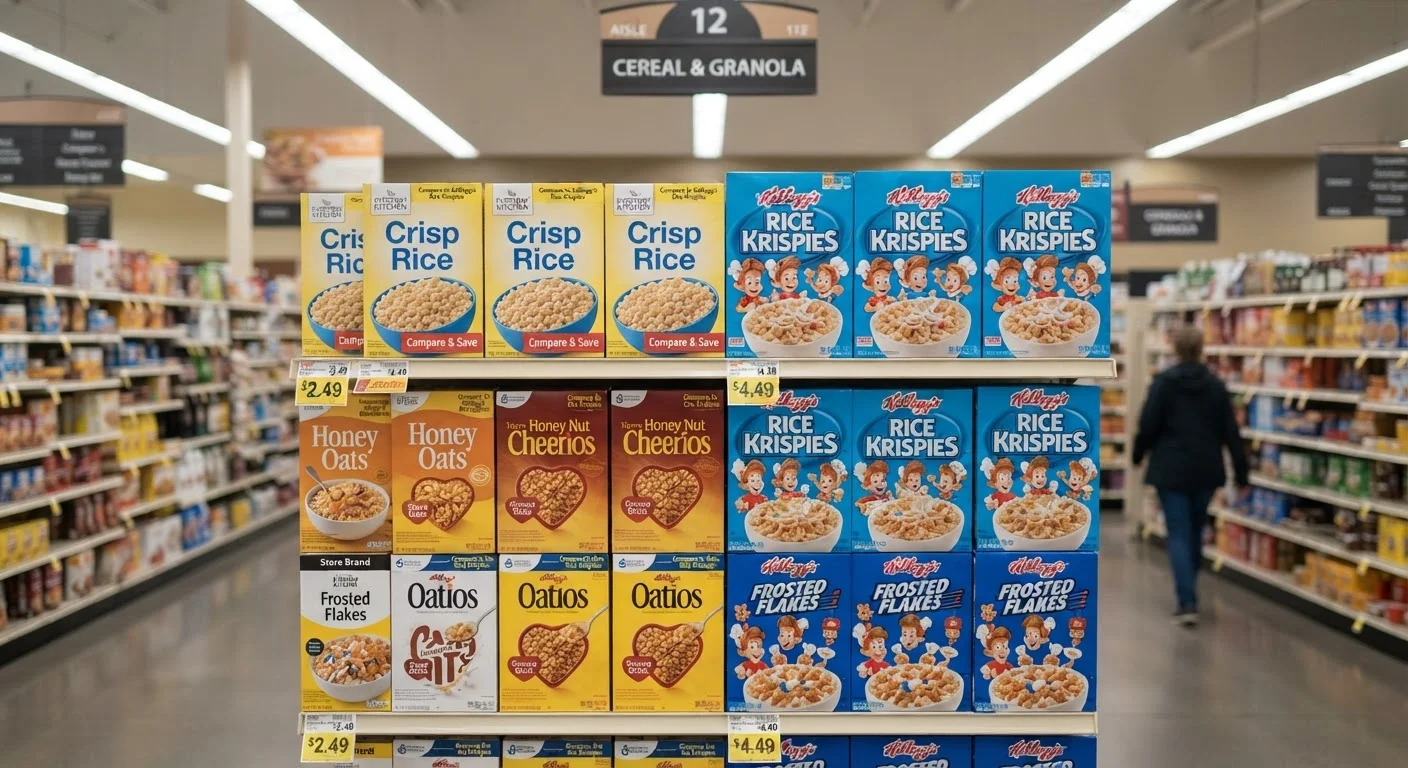
Condiments are the clearest example. Ketchup, hot sauce, and barbecue sauce have proprietary spice blends and sweetness levels that store brands frequently do not match. Families with strong preferences here tend to notice the switch immediately. The same applies to cookies and crackers, where texture and fat ratios affect how the product eats. Certain cereals, particularly those with coatings or specific grain mixes, lose their defining quality in store brand versions.
Cheese-flavored snacks also fall into this group. The seasoning formulas that define well-known products are protected, so store brand alternatives may taste noticeably different, not worse necessarily, but different enough that family members who are attached to the original will register the change.
Understanding private-label manufacturing can help you go further in evaluating specific products. And for a separate but related category, generic versus brand-name medications follow a different logic governed by FDA standards rather than market competition.
How to make the call at the shelf
The ingredient list is the most direct tool available. If the store brand and name brand share the same first three to four ingredients in the same order, the products are almost certainly similar enough to swap. If the name brand uses a more complex spice blend, a different fat source, or a different sweetener, that usually translates to a taste difference worth knowing about before a full switch.
Unit price matters more than the sticker price. Some store brand multipacks carry a higher unit cost than the name brand on sale, so checking the shelf tag's price-per-ounce or price-per-unit column prevents a misleading assumption. Price matching policies at many retailers can bring name brand prices closer to store brand levels for specific items, which shifts the calculation further.
For new store brand switches, buying one unit before stocking up avoids a pantry full of products nobody will eat. Cooking applications, where the product is one element among many, tolerate substitution more than snacking applications, where the product is consumed on its own and any difference is immediately apparent.
The content provided on our blog site traverses numerous categories, offering readers valuable and practical information. Readers can use the editorial team’s research and data to gain more insights into their topics of interest. However, they are requested not to treat the articles as conclusive. The website team cannot be held responsible for differences in data or inaccuracies found across other platforms. Please also note that the site might also miss out on various schemes and offers available that the readers may find more beneficial than the ones we cover.