

How price matching actually works
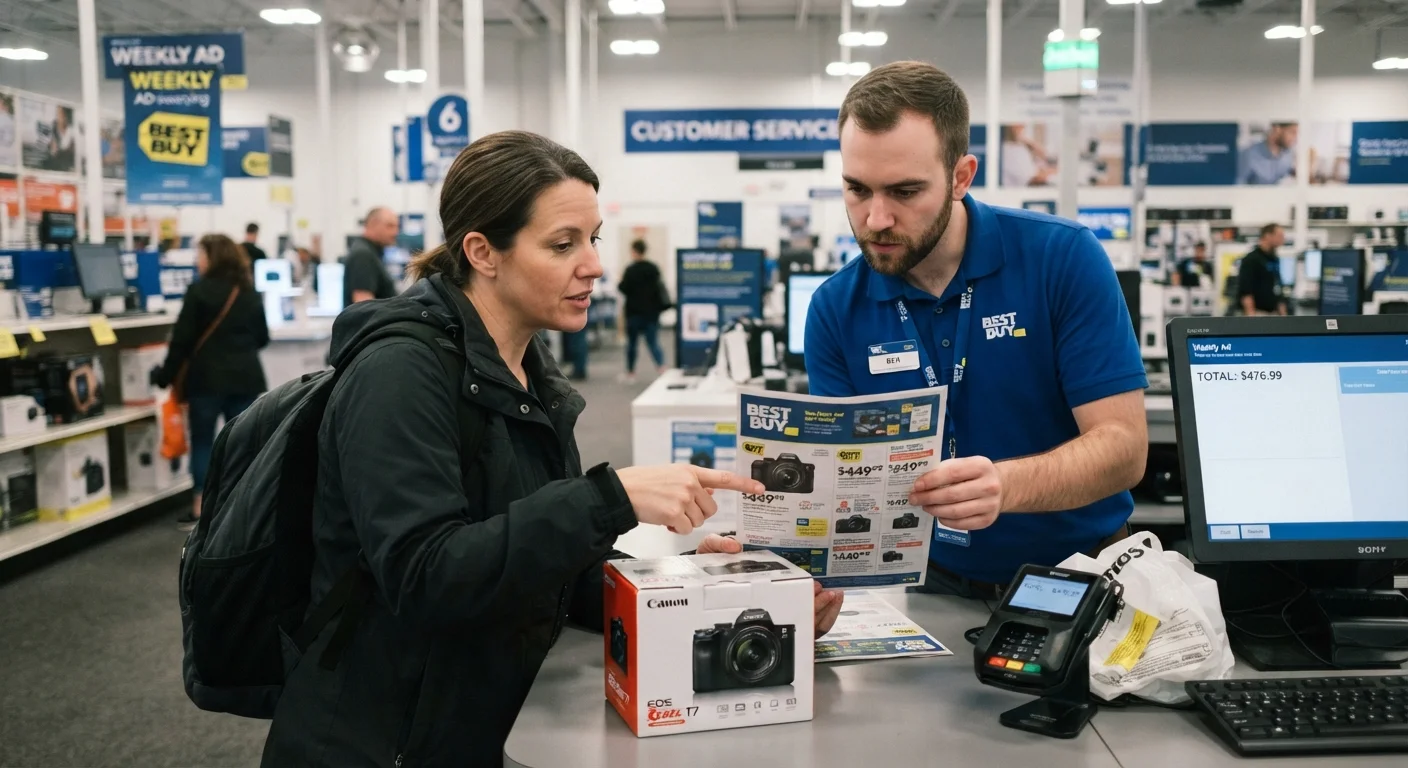
Price matching sounds simple: find a lower price, show proof, pay less. In practice, getting a match approved depends on meeting a set of conditions that vary by store and are rarely posted anywhere obvious. The request typically happens at the register or at a customer service desk, and the associate checks the competing price against the store's written policy before approving anything.
Most policies require the item to be in stock at the competitor at the time you ask. If the other store has sold out, the match is usually void. The product must also be the same in every detail, meaning the brand, model number, size, and color all need to align exactly. Retailers with large electronics or appliance departments tend to apply these rules strictly because manufacturers sometimes create store-exclusive models with slightly different model numbers to prevent direct price comparisons.
Understanding how online prices shift throughout the day matters here too, because a competitor's price you saw this morning may not match what an associate finds when they check it at the counter.
What most policies exclude
The exclusions list is usually where price matching gets complicated. The most common categories that retailers explicitly decline to match include:
- Prices from marketplace sellers (products listed by third parties on a major retailer's site rather than sold directly)
- Prices that require a paid membership to access
- Clearance, closeout, or liquidation prices
- Flash sales, doorbusters, and promotions described as limited-quantity or limited-time
- Bundle or package deals where the price reflects multiple items sold together
- Prices from auction sites
Some retailers add geographic restrictions, declining to match a competitor that does not operate in your region. Others limit matching to a defined list of approved competitors and will not go outside that list regardless of the price difference.
The same kind of fine print that complicates coupons often applies here. If you want to understand how exclusions appear in promotional language more broadly, our article on store coupon terms that limit savings covers similar mechanics.
Check the policy before you shop, not at the register
Most retailers post their price match policy on their website under 'store policies' or 'FAQs.' Reading it before you shop tells you which competitors qualify, what documentation is accepted, and what categories are excluded. Arriving informed means you spend less time at the service desk and have a clearer case to make.
Post-purchase adjustments and time limits
A post-purchase price adjustment is when you return to a store after buying something and request a refund of the difference because the price has since dropped, either at that store or at a competitor. Many retailers offer this, but the window is short. Common adjustment windows run from 7 to 14 days from the purchase date, though some stores have tightened these windows or eliminated the benefit for certain categories.
To make the claim, you typically need the original receipt and current proof of the lower price. Exclusions that applied at the time of purchase still apply during the adjustment window. A clearance price that would have been ineligible at the register remains ineligible for the adjustment.
Post-purchase matching can occasionally be combined with tracking tools or price alert services, but these need to be understood on their own terms. Our piece on cashback apps and browser extensions explains how these tools operate and what affects the deals they surface.
Making a price match request go smoothly
Preparation before you reach the register is the single factor most likely to determine whether a request succeeds. Confirm the competitor's price is current and the item is in stock. Note the exact model number and compare it character by character with the item you are buying. Pull up the competitor's product page on your phone or print it.
Ask to speak with someone who has authority to approve matches if the first associate is unsure. Front-line staff are sometimes unaware of the full policy or may misapply it. Politeness and documentation together get better results than either one alone.
Price matching pairs well with awareness of seasonal pricing patterns. Knowing when a product category is genuinely likely to drop, rather than just be tagged as 'on sale,' helps you decide when to act and when to wait. Our sale calendar by product category explains those patterns in detail. If you are also enrolled in a retailer's loyalty program, check whether matching affects your point accrual, since some stores adjust rewards on price-matched purchases. Our guide to loyalty program mechanics covers how these programs calculate value.
Frequently Asked Questions
Most traditional retailers do not match Amazon listings, especially from third-party sellers on the marketplace. Some stores will match Amazon's own direct-sold listings if the product is identical. Always check the specific retailer's policy before assuming Amazon qualifies.
Many retailers offer a post-purchase adjustment window, typically ranging from a few days to two weeks after your purchase date. You generally need your receipt and proof of the current lower price. Exclusions that apply to standard price matching usually apply to these adjustments as well.
Most policies explicitly exclude clearance prices, going-out-of-business sales, and limited-time flash promotions. Regular sale prices from a qualifying competitor are sometimes accepted, but this varies by retailer.
Many stores now accept a screenshot or live view of the competitor's website on a smartphone. However, some retailers still require a printed circular or will verify the price themselves online. Bring the clearest evidence available and be prepared for the associate to confirm it independently.
Stacking a coupon with a price match depends entirely on each retailer's policy. Some allow it; others treat the matched price as the final price and will not apply additional discounts. Read the fine print or ask before reaching the register.
Retailers generally require the same brand, model number, size, and color. Minor differences, like a different bundle or a retailer-exclusive packaging variant, are usually enough to disqualify the match. Check model numbers carefully before making your case.
The content provided on our blog site traverses numerous categories, offering readers valuable and practical information. Readers can use the editorial team’s research and data to gain more insights into their topics of interest. However, they are requested not to treat the articles as conclusive. The website team cannot be held responsible for differences in data or inaccuracies found across other platforms. Please also note that the site might also miss out on various schemes and offers available that the readers may find more beneficial than the ones we cover.