

Why prices drop when they do
Retail discounts are not random. Prices fall when retailers need to move inventory before a new model cycle, clear space for seasonal merchandise, or respond to predictable drops in demand. Understanding that logic tells you when waiting pays off and when it does not.
Two forces drive most genuine markdowns. First, model-year turnover: manufacturers release new versions on fairly consistent schedules, and retailers discount older stock to clear shelves. Second, demand seasonality: items tied to a specific season get cheaper once that season peaks, because holding unsold inventory costs money. Neither of these forces applies equally to every category, which is why some products go on deep sale reliably and others almost never do.
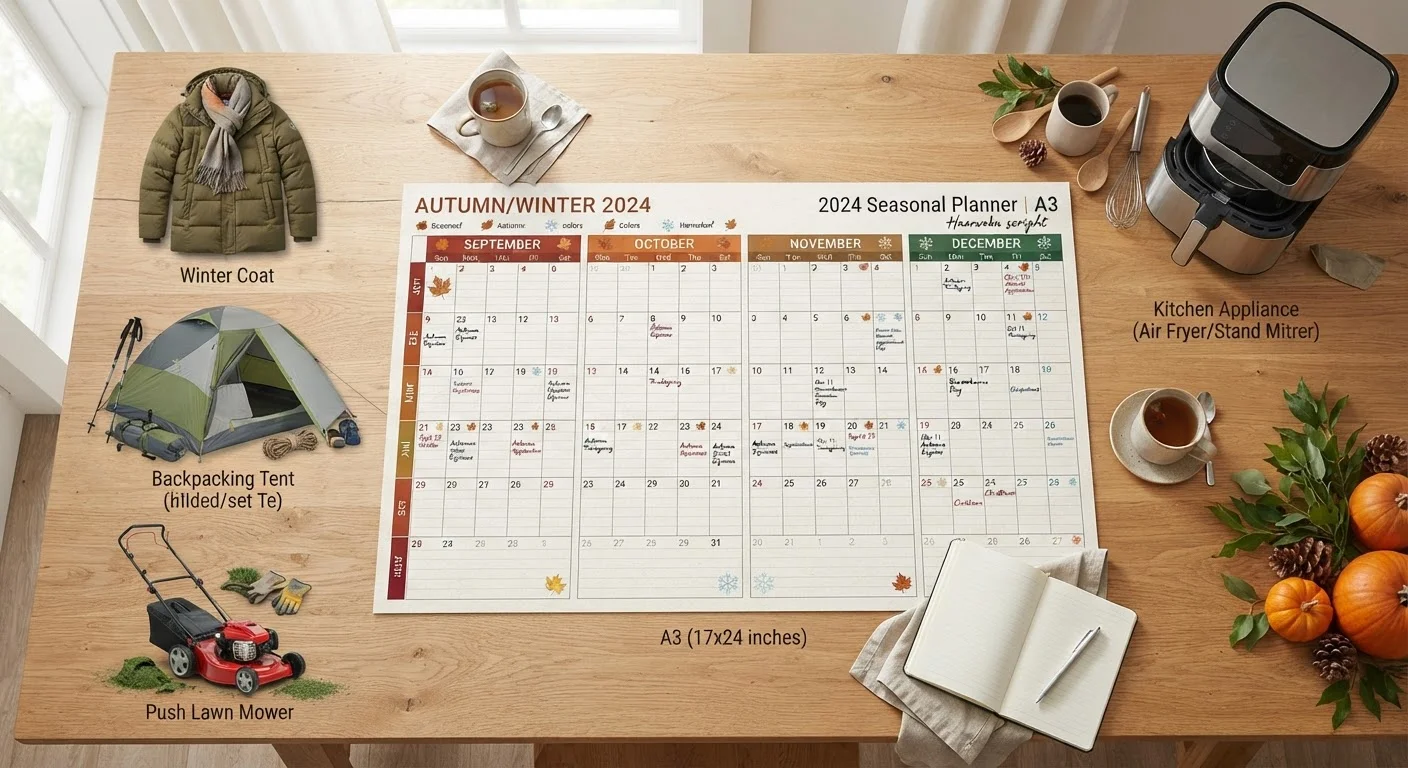
Common shopping myths can make it easy to assume that any "sale" tag represents a genuine price drop. The discount calendar below is grounded in inventory cycles rather than marketing tactics.
Categories with predictable seasonal lows
Major appliances (refrigerators, ranges, dishwashers): New appliance models arrive at retailers in September and October. The window from late August through October is when prior-year floor models get reduced. A second, smaller window opens in January, when post-holiday floor space gets reorganized. Appliances rarely go on deep sale outside these windows, so if you can plan ahead, those months are worth targeting.
Outdoor and lawn equipment: Prices drop sharply in late summer (August onward) as demand for mowers, grills, and patio furniture falls. Retailers discount aggressively through September to avoid warehousing seasonal inventory. Buying a grill in September rather than May can mean a meaningfully lower price for the same item.
Winter clothing and outerwear: Department stores and outdoor retailers clear winter apparel starting in late January and continuing through February. Coats, boots, and heavy sweaters typically see their steepest discounts then. The trade-off is limited size availability late in the season.
Fitness equipment: January brings a spike in demand (and full prices). By March, demand normalizes and unsold inventory starts to get marked down. Late March through April is the practical window for treadmills, stationary bikes, and weight sets.
Televisions: The period around the big February sports championship and the weeks before and after Black Friday in November produce the most consistent TV discounts. New screen models are announced at the Consumer Electronics Show in January, which also softens prices on prior-year sets in February and March. Online pricing for electronics shifts frequently, so tracking a specific model over a few weeks before buying gives a clearer picture of what a genuine low looks like.
Mattresses: Memorial Day, Labor Day, and Presidents Day weekends have historically been heavy mattress sale periods. These coincide with retailer promotional calendars rather than strict inventory cycles, but the discounts during those weekends are generally real rather than inflated-then-reduced.
Categories that rarely go on deep sale
Some product categories have tight supply chains, high ongoing demand, or low inventory-carrying costs, all of which reduce the retailer's motivation to discount deeply.
Groceries and household staples: Everyday consumables cycle through modest promotions constantly, but deep clearance sales are uncommon because the inventory turns over fast anyway. Seasonal produce is an exception: prices drop when local supply peaks. Seasonal produce pricing follows a different logic than durable goods.
Smartphones (current flagships): Manufacturers tightly control launch pricing. Genuine discounts on current flagship models are rare within the first six months of release. Older models do get discounted when successors launch, typically in September and March for the major brands.
Toys during the holiday season: Popular toys rarely drop in price between October and December. Retailers have no reason to discount items that will sell at full price. January clearance is the only reliable window.
If a product in these categories appears deeply discounted outside its normal window, it is worth checking whether the model has been discontinued, the item has cosmetic damage, or a newer version is about to arrive. Price matching policies can also help capture a lower price you find elsewhere without waiting for a sale.
How to use this information practically
Building a rough purchase calendar takes about ten minutes. List the items your household expects to need in the next twelve months, then map each to its seasonal low window. For anything that can wait, hold off and set a reminder for the discount window. For anything urgent, check whether a retailer's price-match program covers the category.
A few practical notes. Discount depth varies by retailer and year; the windows above represent patterns, not guarantees. Clearance items sometimes have limited warranty coverage or are final sale, so confirm return and warranty terms before buying. And the best price in a given window is not always the best value if a product's reliability record is poor. Secondhand options can sometimes beat even clearance pricing on certain durable goods like furniture.
The goal is to convert a reactive, impulse-driven shopping habit into a planned one. The discount calendar does not require sacrifice; it just requires knowing which purchases can wait a few months and which cannot.
The content provided on our blog site traverses numerous categories, offering readers valuable and practical information. Readers can use the editorial team’s research and data to gain more insights into their topics of interest. However, they are requested not to treat the articles as conclusive. The website team cannot be held responsible for differences in data or inaccuracies found across other platforms. Please also note that the site might also miss out on various schemes and offers available that the readers may find more beneficial than the ones we cover.